
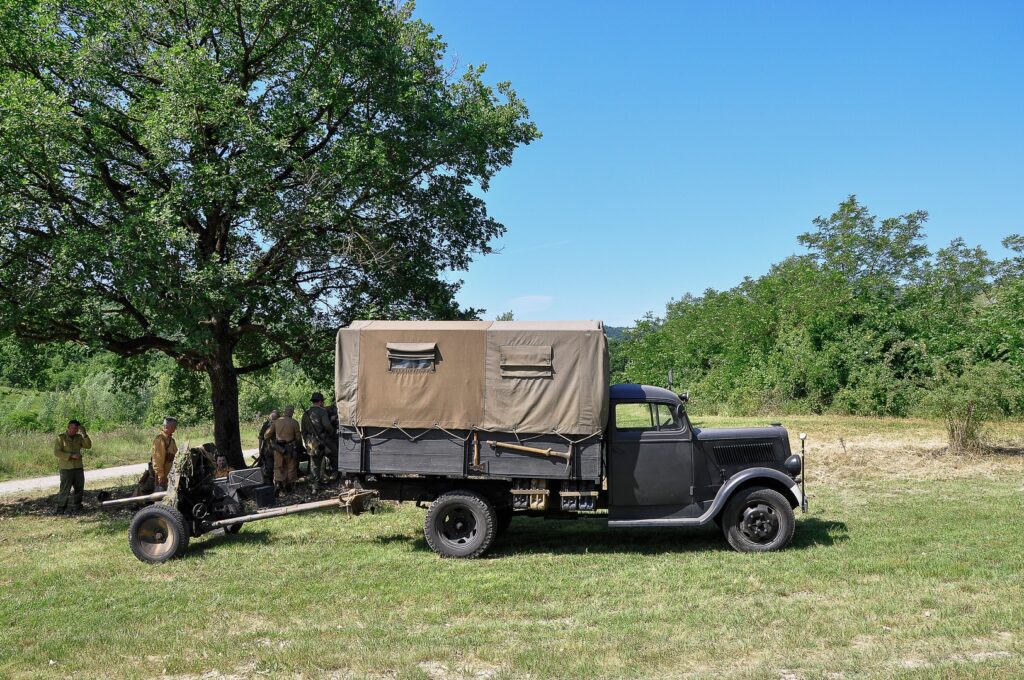
At first glance, the Opel Blitz 2.5-32 seems like the kind of truck that in 1938 could have lived a respectable life among crates, tools, and deliveries. It’s a truck like any other, but then you open the hood and you’re surprised: a six-cylinder in-line engine, 2,473 cc, and 55 hp. For a 1.5-ton truck, this was a feature that gave it a certain pep.
Production of the 2.5-32 began in 1938. The engine was a liquid-cooled six-cylinder gasoline engine, mated to a four-speed manual transmission and rear-wheel drive. Top speed was around 80 km/h. These figures seem ridiculous today, but in 1938, on a truck with narrow tires, leaf spring suspension, and a cabin filled with vibrations and mechanical noise, 80 km/h could take on an almost philosophical meaning. At that speed, the driver quickly learned to distinguish the engine noise from the sounds of his own worries. The six-cylinder engine was one of the most attractive aspects of the Blitz. Opel also used it in its cars, including the Super 6 and the new Kapitän. Putting it under the hood of a truck meant giving a commercial vehicle an engine familiar from premium cars. The result was a truck with a surprisingly lively personality, especially considering its commercial vocation.
Even the name, Blitz, meaning “lightning,” thus acquired a certain credibility. For once, the marketing department had maintained a reasonable relationship with reality.
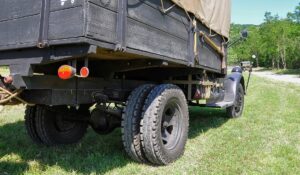
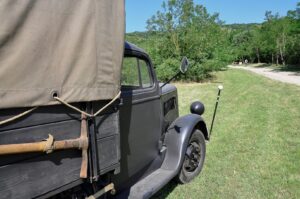
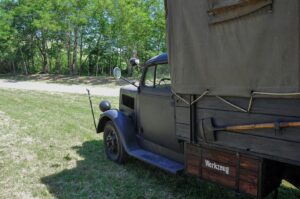
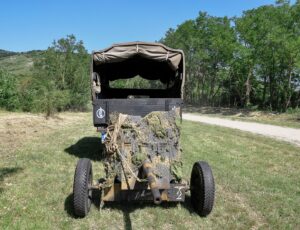
The small Blitz also arrived at a decisive moment for Opel. The Rüsselsheim-based manufacturer had by then transformed the truck into a modern industrial product, and the success of the range had led to the construction of a large specialized plant in Brandenburg an der Havel. The foundation stone was laid on April 7, 1935, and the plant was designed for mass production. The area covered approximately 850,000 square meters: enough space to make one’s backyard seem decidedly inadequate for truck production.
Brandenburg became the heart of heavy and medium Blitz production, while the 2.5-32 was built in Rüsselsheim. Historical sources indicate approximately 16,410 units were produced between 1938 and 1942, a significant achievement for a model intended for the 1.5-ton segment.
Then came 1939, and the world changed its profession.
The Blitz was born to transport goods, but the war quickly transformed the truck into a military logistics pawn. The 2.5-32 was used by the Wehrmacht in numerous roles and could be configured in various ways: as a box body, a van, a personnel carrier, a mobile workshop, an ambulance, and other specialized equipment. In war, a truck rarely retains a single purpose throughout its entire life. If it has four wheels, a reliable engine, and enough space behind the cab, someone will certainly find something to transport.
The Blitz thus entered the gigantic German logistical machine. Truck convoys were essential for supplying fighting units, transporting fuel, ammunition, food, spare parts, and personnel. Modern warfare depended on logistics with almost bureaucratic precision: an army might have men, tanks, and artillery, but without fuel and supplies, it quickly became an army with many opinions and little room for movement.
The Blitz contributed precisely to this invisible work.
During the French campaign of 1940, in the war on the Eastern Front from 1941 onward, and in subsequent operations, trucks became the daily protagonists of military mobility. The Blitz belonged to the lighter category of vehicles, while the famous 3-ton Blitz was the Wehrmacht’s main Opel truck. The similarity between the various versions made the Blitz name a familiar presence in the vast German vehicle fleets.
The Blitz 2.5-32 was a rear-wheel drive vehicle and belonged to a category designed primarily for ordinary roads. Mud, snow, ice, and devastated terrain tested any conventional truck. For this reason, the all-wheel drive versions of the heavier Blitzes also gained particular importance in the history of the Wehrmacht, and especially the famous Maultiers, trucks converted with a rear track system to increase mobility on difficult terrain. These were machines so curious-looking they seemed to have been designed during a particularly long and probably noisy discussion in a workshop.
The 2.5-32, however, remained a simpler and more compact machine, valuable precisely for its versatility. Its size made it suitable for tasks where a heavy truck would have been an unnecessary luxury. In a war fought over enormous distances, each vehicle’s value was directly proportional to its ability to keep moving.
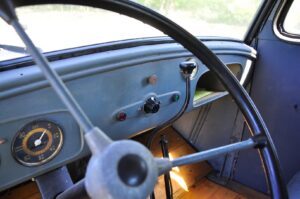
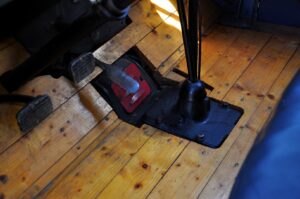
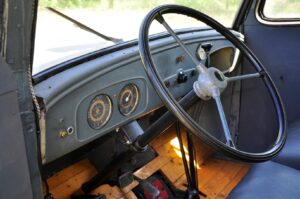
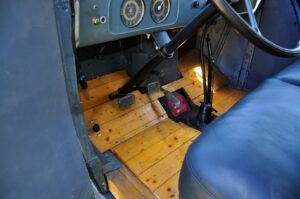
Production of the model ended in 1942, while the war forced an increasing concentration of industrial resources on priority vehicles. The story of the Blitz, however, still had a surprising chapter ahead of it.
In the postwar period, Germany was a landscape of damaged factories, blocked roads, and cities in need of reconstruction. Rüsselsheim itself had suffered heavy destruction. Yet, on July 15, 1946, Opel returned to production with a Blitz.
The choice has something almost cinematic. A factory restarting its operations with a car would have told a story of normality. Restarting with a truck, on the other hand, told a story of necessity.
They needed building materials, wood, food, tools, spare parts. Everything that allowed a country to put itself back together was needed. The first Blitz produced after the war was purchased by a Wiesbaden entrepreneur for 6,600 marks. The production restart ceremony was attended by American General Geoffrey Keyes, who symbolically cut a yellow ribbon.
In 1946, 839 Blitzes rolled off the production line. Production of the postwar version continued until 1951, reaching 37,117 units. The truck that had survived the war thus entered a different era, with a much less dramatic and perhaps even more important task: helping Germany get back on the road.
It is this transition that makes the Blitz 2.5-32 particularly fascinating. Its history encompasses the automotive industry of the 1930s, military motorization, the logistics of the Second World War, and the reconstruction of Europe. All within a vehicle that, ultimately, retains an almost disarming simplicity.
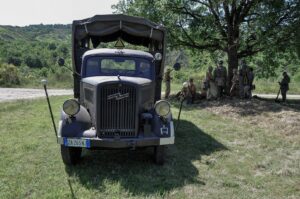
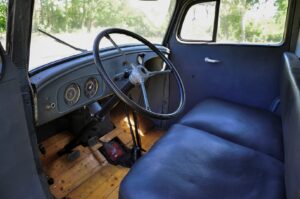
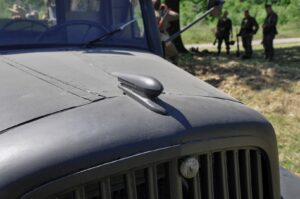
A long hood, a large grille, separate fenders, twin rear wheels, and a cockpit in which the driver had a much more direct relationship with the mechanics. Every control had weight, every sound spoke volumes, every start was a small ceremony.
And when a 1938 model, still intact, appears today, that austere face slowly begins to change expression.
A turn of the key, a rumble from the hood, a few vibrations running through the chassis, and the old Blitz almost seems to be preparing for a new day.
After all these years, he still retains a certain self-confidence. After all, he’s already been through a war: a country road probably feels like a vacation to him.
His name promised lightning, his exploits helped create a legend. And the rest, as often happens with truly successful machines, is still told today by the sound of the engine when someone turns the key and says, with absolute ease, “Shall we go?”
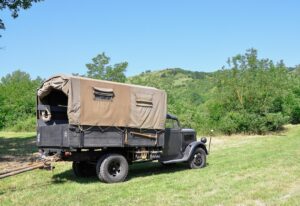
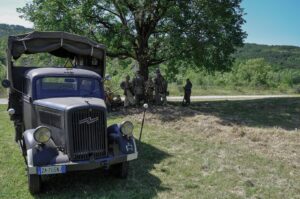
Before us, we can admire one of the more than 16,000 Blitz 2.5-32s ever produced, magnificently preserved and still proudly driven to rallies by its owner, Alfonso. And it is precisely here that the truck’s history ceases to belong solely to the archives and begins to become a personal story.
Alfonso says he found the Blitz almost by chance, during one of his many explorations of websites dedicated to historic vehicles. He hadn’t set out with the specific intention of purchasing that particular model. Then he saw it. Those photographs were enough to spark something we know well in the world of collectors: reasoning quickly gives way to enthusiasm.
A few days later, he was in Germany.
The trip served to bring home a truck, of course, but also to begin a friendship. The Blitz’s German owner turned out to be a passionate collector, with that rare openness often found among people sharing a shared obsession with old cars. They talked, comparing stories, photographs, spare parts, and projects. And, as happens in the best automotive adventures, the affair didn’t end with the change of ownership.
Some time later, that new friendship would have a surprising sequel. The German collector helped Alfonso recover another vehicle, also of German origin, very important and decidedly rarer. It’s one of those stories that begins with an ad stumbled upon almost by chance and ends with a truck on a trailer, miles of road ahead, and someone who, probably, at home, is still thinking that it would have been easier to collect stamps.
And perhaps this is precisely the privilege of rallies: bringing these vehicles back to their natural element for a few hours. The Blitz is no longer an archive photograph, a line in a catalog, or a number in an industrial statistic. It’s there, before our eyes, with its paint, the smell of mechanics, the metal, the wheels, and that six-cylinder engine reminding everyone that in 1938 someone had the brilliant idea of putting such an engine under the hood of a relatively compact truck.
Alfonso brings it to rallies with pride, and it’s easy to understand why.
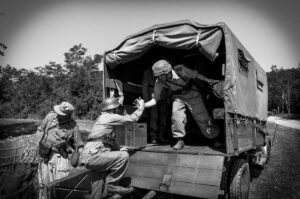
Every preserved historic vehicle tells a story of its era. But those that continue to travel add a personal chapter: that of those who sought them out, recovered them, restored them, and then decided to put them back on the road instead of simply leaving them immobile in a private museum.
Alfonso’s Blitz belongs to this category.
It began its career in a completely different Europe, lived through the most dramatic years of the twentieth century, survived long enough to become a piece of history, and, in the end, even managed to bring together two collectors separated by a border.
Which is a fine career for a truck.
Alfonso turns the key.
The six-cylinder engine sputters.
The truck shakes.
“Shall we go?”
Judging by Blitz’s face, it was just what he was waiting for.
All the images are from Rusty Pelican.

